
BHARTIYA SCHOOL OF PUBLIC HEALTH • MASTER OF PUBLIC HEALTH
IMPROVING HEALTH.
SHAPING COMMUNITIES.
Step beyond routine bedside treatment into scalable healthcare leadership. Master epidemiology, biostatistical modeling, health policy, and program management to qualify for impactful careers across National Health Missions, multilateral agencies, and global health research.

Master of Public Health (MPH)
2 Years • 4 Semesters • Affiliated to UGC-Approved Govt University
MASTER OF PUBLIC HEALTH
2-Year / 4-Semester Master Degree
UNIVERSITY AFFILIATION
Affiliated to UGC-Approved Govt University
INSTITUTION
Bhartiya School of Public Health
LOCATION
Roorkee, Uttarakhand
Health Is More Than Healthcare.
While clinical medicine treats individuals who are already unwell, public health protects entire populations. It focuses on prevention, health systems, environments, policies, and community resilience to improve lives before illness strikes.
Treating One Patient at a Time
Focuses on diagnosis, curative therapies, and individual medical care after symptoms appear inside hospitals and clinics.
Protecting Entire Communities at Scale
Focuses on prevention, epidemiology, health systems, policy reform, and population-scale interventions to safeguard millions.
Prevention & Wellness
Halting disease before it emerges through immunization campaigns, lifestyle interventions, and systemic community health safeguards.
Epidemiology & Surveillance
Analyzing patterns, outbreak clusters, disease transmission vectors, and population vulnerabilities to guide targeted health actions.
Health Policy & Governance
Formulating equitable healthcare legislations, allocating public resources, and designing robust national health mission policies.
Community Health & Fieldwork
Mobilizing rural and underserved populations, empowering local health workers, and resolving sociocultural barriers to care.
Health Systems & Infrastructure
Optimizing healthcare delivery networks, primary health centres (PHCs), hospital management systems, and referral pathways.
Health Promotion & SBCC
Crafting persuasive social and behavior change communication to promote maternal health, sanitation habits, and mental well-being.
Environmental Health & Sanitation
Assessing the impacts of safe drinking water, air quality, industrial pollutants, and climate change on population health outcomes.
Health Data & Biostatistics
Leveraging digital health information registries, statistical modeling, and surveillance metrics to drive evidence-based interventions.
THE MPH EXPERIENCE
A comprehensive postgraduate program designed to develop critical thinking, analytical capability, and practical understanding of public health challenges across communities and health systems.
Public Health Thinking
Developing the intellectual framework to view health beyond individual clinical care—analyzing disease patterns, ecological drivers, prevention strategies, and systemic determinants of well-being across diverse populations.
Research & Evidence
Mastering epidemiological research designs, biostatistical analysis, quantitative and qualitative field methods, and systematic evidence synthesis to inform robust, defensible public health policies and interventions.
Community Perspective
Direct immersion into community health realities, understanding local sociocultural dynamics, health disparities, vulnerable demographic challenges, and participatory approaches to community-led health solutions.
Health Systems & Policy
Deep study of healthcare delivery architectures, health financing mechanisms, national health missions, regulatory frameworks, policy formulation cycles, and institutional governance at district, state, and national levels.
Data & Decision Making
Harnessing health information systems, disease surveillance networks, demographic health surveys, and geospatial health data to transform complex population metrics into decisive public health action.
Leadership & Management
Equipping postgraduates with essential capabilities in public health program planning, financial budgeting, monitoring and evaluation (M&E), emergency preparedness, and strategic stakeholder communication.
Technical Tooling & Real-World Methodologies Mastered
Hypothesis testing, regression modeling, and survey analysis.
Geospatial clustering of disease outbreaks and resource access.
Paperless mobile data collection and participatory community appraisals.
Results-based management frameworks used by UN, NHM, and NGOs.
Want to see how these pillars translate into coursework?
Explore the four-semester modular curriculum structure affiliated to an UGC-approved government university.
EXPLORE THE CURRICULUM
A modular, comprehensive 2-year (4-semester) postgraduate curriculum designed to cover foundational, methodological, and applied public health disciplines across four semesters.
Foundations & Quantitative Methods
Establishes fundamental concepts of population health, the biological and social drivers of disease, and initial competency in quantitative epidemiology and biostatistics.
Foundations of Public Health
Evolution of public health, global disease burden, public health ethics, and ecological paradigms of population health.
Principles of Epidemiology
Measures of disease frequency, descriptive and analytical epidemiology, bias, confounding, and causal inference.
Introduction to Biostatistics
Probability distributions, hypothesis testing, sampling methods, confidence intervals, and introductory statistical software.
Social Determinants of Health
Structural inequalities, socioeconomic status, gender dynamics, culture, and their impact on community vulnerability.
IS MPH FOR YOU?
Public health is inherently multidisciplinary. Our Master of Public Health program brings together graduates from medicine, health sciences, biology, and social sciences to tackle health challenges collectively.
Medical & Dental Graduates
Clinicians transitioning from repetitive OPD routines and shift burnout into healthcare administration, disease surveillance, health policy, and non-bedside leadership.
AYUSH Practitioners
AYUSH doctors seeking formal training in modern epidemiological methods, evidence-based biostatistics, and integrative public health programming.
Nursing & Allied Health
Professionals leveraging intensive patient-care grounding to step into hospital quality accreditation, infection control directorship, and clinical research coordination.
Pharmacy & Life Sciences
Graduates bridging biological and chemical sciences with clinical data management, vaccine policy, epidemiological surveillance, and healthcare data analytics.
Social Sciences & Humanities
Social researchers dedicated to dismantling structural determinants of disease—sanitation, poverty, maternal nutrition, and health equity communication.
Development & NGO Professionals
Field professionals seeking formal master’s credentials in biostatistics, health economics, and grant administration to step into senior executive roles.
Check If Your Background Fits
Quick self-assessment for prospective postgraduate applicants
WHERE CAN PUBLIC HEALTH TAKE YOU?
Public health professionals work across diverse sectors in India and internationally—from community-level field initiatives to state health departments, research institutions, and international development agencies.
Public Health Organizations & NGOs
Leading grassroots intervention programs, maternal and child health drives, nutrition surveys, and rural health interventions across non-governmental and civil society bodies.
Government Health Programs & Missions
Supporting national and state health missions (such as National Health Mission), district-level disease surveillance cells, immunization campaigns, and public health administration.
Research Institutes & Think Tanks
Designing population health studies, analyzing complex biostatistical registries, publishing empirical findings, and contributing data-driven evidence to health policy debates.
Healthcare & Hospital Systems
Enhancing hospital accreditation standards (NABH/JCI), implementing antimicrobial stewardship protocols, patient safety indices, and streamlining healthcare delivery workflows.
Health Consulting & Development Agencies
Advising philanthropic foundations, corporate social responsibility (CSR) programs, and development consultancies on health financing, program efficacy, and policy design.
Academia & Higher Education
Contributing to the education of future health professionals, conducting funded academic studies, and advancing foundational scholarship in public health sciences.
Where Public Health Leadership Is in High Demand
Public health is one of the few fields bridging public governance, international development, corporate sustainability, and cutting-edge data science.
- • National Health Mission (NHM)
- • State Health Societies
- • IDSP Disease Surveillance Cells
- • ICMR Field Research Centers
- • Technical Support Units (WHO/UNICEF)
- • PATH & Jhpiego
- • Clinton Health Access Initiative (CHAI)
- • CARE India & Global Fund Partners
- • Tata Trusts Health Initiatives
- • Piramal Swasthya Tele-care
- • Reliance Foundation Healthcare
- • Corporate CSR Health Portfolios
- • Clinical Research Organizations (CROs)
- • Pharmacovigilance & Trial Audits
- • Health Economics (HEOR) Units
- • Health Insurance TPA Analytics
Career trajectories and organizational appointments depend on individual academic merit, prior undergraduate specialization, competitive selection processes, organizational requirements, and government recruitment norms. Bhartiya School of Public Health provides rigorous academic training and does not make fabricated placement guarantees or unsubstantiated salary claims.
PUBLIC HEALTH WITH PURPOSE
Bhartiya School of Public Health is committed to delivering quality public health education rooted in real-world challenges, ethical responsibility, and rigorous academic inquiry.
Academic Environment
A structured postgraduate learning atmosphere bringing together faculty and scholars across medicine, life sciences, epidemiology, and social sciences to dissect complex population health issues.
Community Engagement Focus
Education rooted in field immersion. Our approach integrates classroom pedagogy with rural community assessments, understanding grassroots barriers to healthcare delivery in northern India.
Research-Oriented Approach
Emphasis on epidemiological methods, statistical inquiry, and public health ethics—preparing scholars to generate rigorous evidence that can guide healthcare policy and programmatic interventions.
Strategic Location in Uttarakhand
Situated in Roorkee / Haridwar district, offering unparalleled exposure to varied public health terrains—from densely populated industrial plains and pilgrimage epicenters to remote Himalayan hill districts.
Unit of Bhartiya Mahavidyalaya
Established in 2015, Bhartiya Mahavidyalaya has been dedicated to accessible higher education in the Roorkee region, building modern campus infrastructure and student-centered academic ecosystems.
Government University Affiliation
Our Master of Public Health program is affiliated to an UGC-approved state government university establishing verified academic standards.
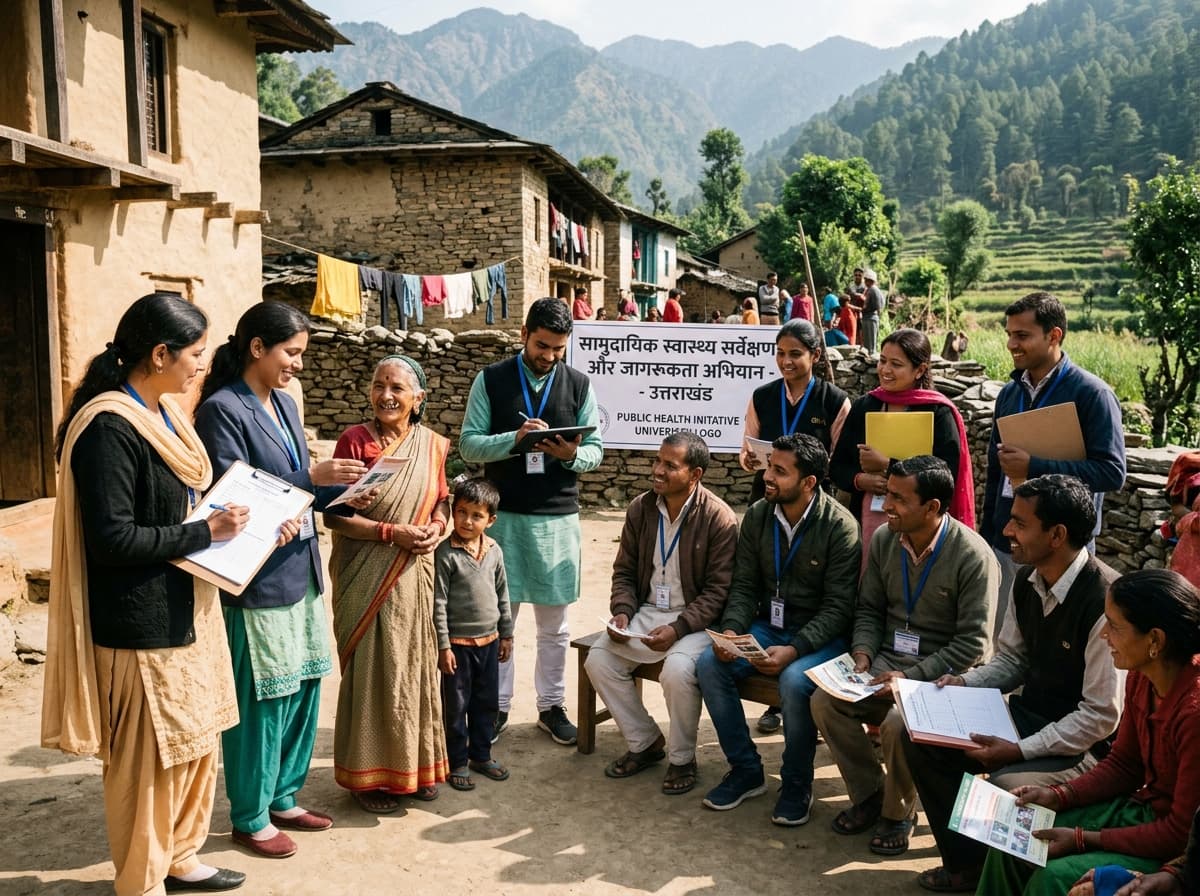
Rooted in Community Realities. Focused on Population Health.
Our scholars engage in direct grassroots health assessments, working alongside community workers across the plains and hill districts of Uttarakhand to understand primary healthcare delivery and disease determinants.
STUDY IN ROORKEE, UTTARAKHAND
A historic educational epicenter offering an ideal, scholarly atmosphere for focused postgraduate study, with direct connectivity across Uttarakhand and Northern India.
Home to IIT Roorkee and established centers of higher learning, cultivating a quiet, scholarly atmosphere.
Proximity to agrarian plains, industrial corridors, and Himalayan hill health ecologies for field studies.
Well-connected through Roorkee & Haridwar railway junctions to Delhi NCR, Dehradun, and Chandigarh.
Situated along major national expressways connecting Western UP, Uttarakhand plains, and the NCR.
ADMISSION PROCESS
A clear, structured pathway to joining the 2-year (4-semester) Master of Public Health (MPH) degree program at Bhartiya School of Public Health.
Explore the Program
Review curriculum modules, academic pillars, and public health career pathways to assess alignment with your professional aspirations.
Check Eligibility
Verify bachelor's degree requirements across medical, life sciences, or social disciplines as per university notification guidelines.
Apply Online
Complete the comprehensive online application form covering academic credentials, professional experience, and public health areas of interest.
Admissions Review
Application profiles are evaluated by the admissions committee based on academic merit, discipline background, and statement of purpose.
Document Verification
Submission and scrutiny of official undergraduate transcripts, degree certificates, category certificates (if applicable), and identity verification.
Admission Confirmation
Issuance of formal offer docket, provisional enrollment, university registration procedures, and orientation schedule confirmation.
READY TO MAKE AN IMPACT?
Join the 2-Year (4-Semester) Master of Public Health program at Bhartiya School of Public Health and build a rewarding career dedicated to population health, health systems, and human well-being.
Affiliated to: UGC-Approved Government University